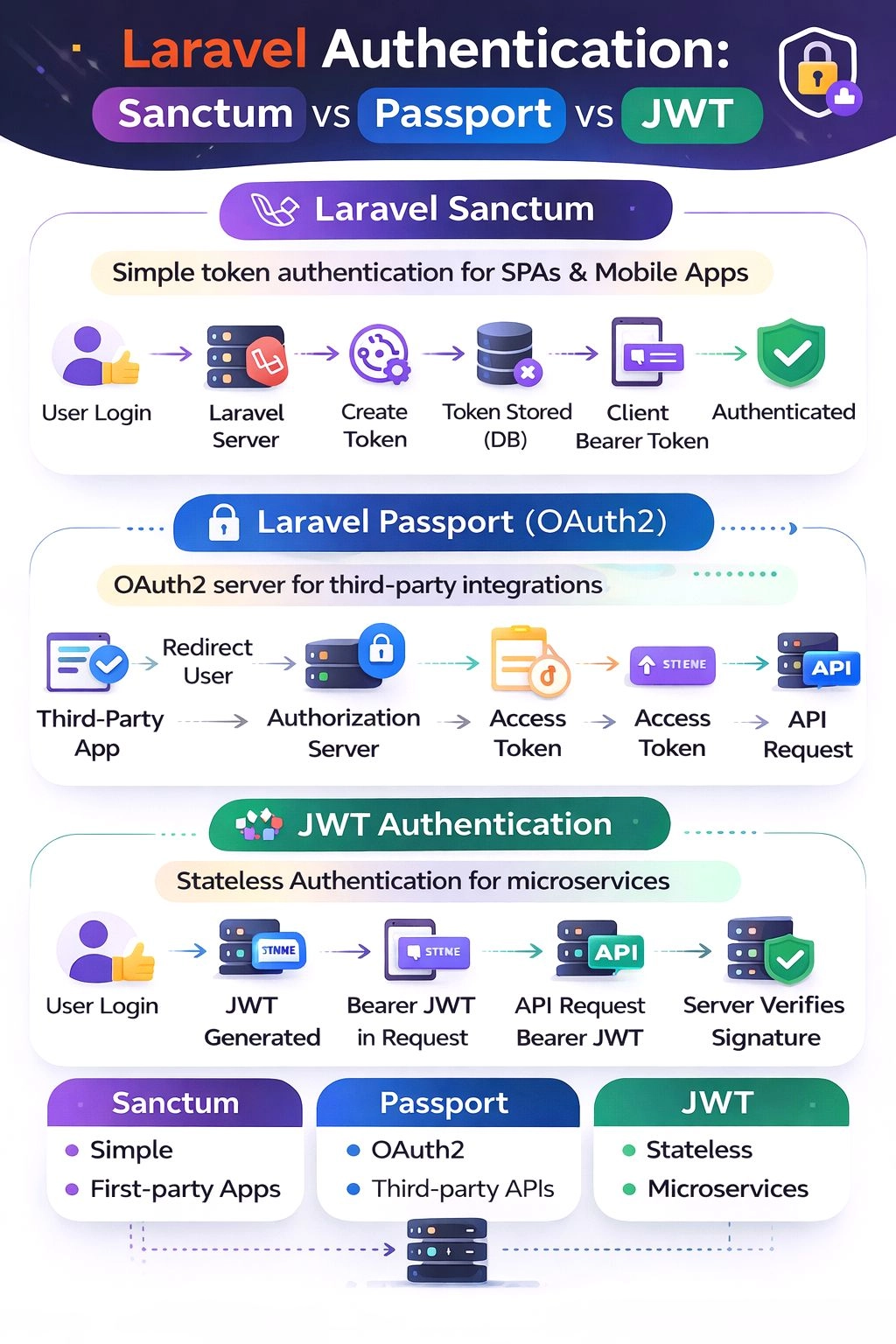
Laravel Authentication: Sanctum vs Passport vs JWT
When building APIs in Laravel, developers often ask:
Should I use Sanctum, Passport, or JWT?
All three handle authentication, but they solve different architectural problems.
🔐 1️⃣ Laravel Sanctum
Framework: Laravel Sanctum
Best for:
SPA applications (React / Vue)
Mobile apps
First-party APIs
How it works technically
Sanctum provides two authentication modes:
1️⃣ Cookie-based session authentication (for SPAs)
2️⃣ API tokens (for mobile or external clients)
Token Flow
User logs in.
The server generates a personal access token.
The token is stored in the database (personal_access_tokens table).
Client sends the token in the request header.
Example:
Authorization: Bearer 1|xF9kslKjdsf93ksd...
Internally Sanctum:
Hashes the token
Stores the hash in DB
Matches incoming tokens via middleware
Resolves the authenticated user
Key Characteristics
✔ Lightweight
✔ Simple setup
✔ Database-backed token validation
✔ Ability-based permissions
Architecture:
Stateful or semi-stateless, depending on implementation.
🔐 2️⃣ Laravel Passport
Framework: Laravel Passport
Protocol: OAuth 2.0
Best for:
Public APIs
Third-party integrations
Enterprise platforms
Passport turns Laravel into a full OAuth2 authorization server.
It supports multiple grant types:
• Authorization Code Grant
• Password Grant
• Client Credentials
• Personal Access Tokens
• Refresh Tokens
Authorization Code Flow
Client App
↓
Redirect the user to the authorization server.
↓
User authenticates
↓
Authorization code returned
↓
Client exchanges code for an access token.
↓
Client calls the API using the access token.
Passport creates several tables:
oauth_clients
oauth_access_tokens
oauth_refresh_tokens
oauth_auth_codes
Key Characteristics
✔ Full OAuth2 implementation
✔ Secure delegated authorization
✔ Token scopes and refresh tokens
✔ Ideal for third-party developer ecosystems
Tradeoff: heavier infrastructure and configuration.
🔐 3️⃣ JWT Authentication
Standard: JSON Web Token
Best for:
Microservices architecture
Stateless APIs
Distributed systems
JWT is a stateless authentication mechanism.
Instead of storing tokens in a database, the token itself contains the Token signature:
HMACSHA256(
base64(header) + "." + base64(payload),
secret_key
)
Request example:
Authorization: Bearer eyJhbG..
The server only verifies the signature — no database lookup required.
Key Characteristics
✔ Fully stateless
✔ Fast authentication
✔ Ideal for distributed systems
🧠 Rule of Thumb
• Use Sanctum → Most Laravel apps (SPA + mobile APIs)
• Use Passport → If you're building a public developer platform
• Use JWT → If you're designing stateless microservices
💡 Pro tip:
Many modern systems combine OAuth2 authorization with JWT access tokens for scalable distributed authentication.
Article
•
Technology
Sanctum vs Passport vs JWT
Ads
Advertise with us! Get in touch to showcase your brand.
Latest Posts
5
Sanctum vs Passport vs JWT
Mar 06, 2026
Mar 06, 2026
Laravel Scope Tip
Mar 04, 2026
Mar 04, 2026
Scheduled commands or queue jobs Tip
Mar 04, 2026
Mar 04, 2026